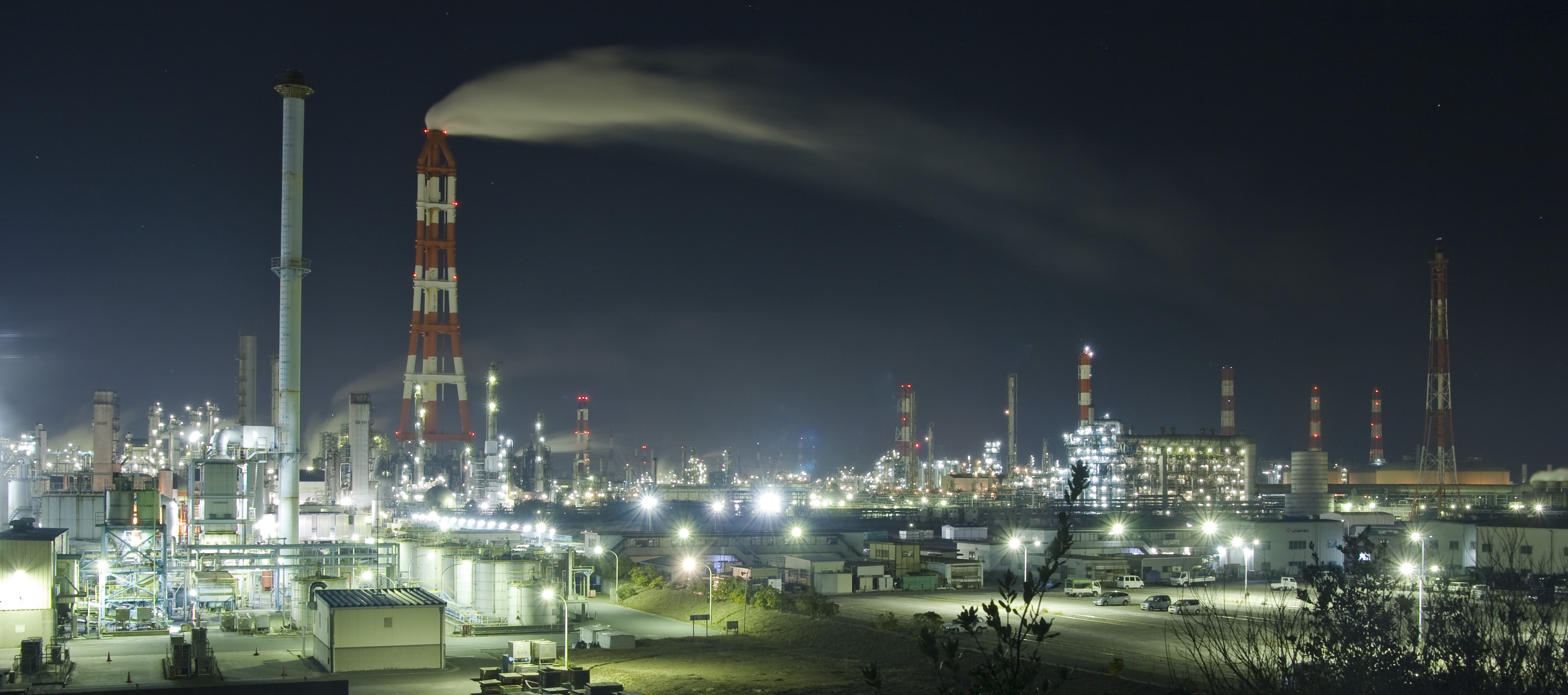
The Promise Already Made: Japan's GX ETS
25/8/2026


Japan's GX ETS becomes mandatory from the 2026 financial year (FY2026), covering around 600 companies that emit more than 100,000 tonnes of CO2 a year. For the first seven years it will pay most of them.
In a new report by our friends at Transition Metrics, asset-based data from Asset Impact is put to use in modelling the impact of Japan's incoming carbon pricing regime on the firms subject to it.
Read the full report here. The Promise Already Made: Japan's GX ETS, produced jointly with Transition Metrics.
The analysis finds that free allocation is generous enough that the companies we model hold net surpluses through 2032 and actually earn money from the scheme. Once power-sector auctioning begins in 2033, the position inverts. Working from Asset Impact's asset-level data in Japan, the paper models allowance balances and carbon costs to 2040 for around 200 parent companies across power, steel, cement, aluminium and oil and gas. Together they account for about 60% of the Scope 1 emissions reported by Nikkei 225 constituents, and around 90% once their unlisted joint ventures are attributed to the listed parents.
Benchmark-based allocation sets each company's cap using average reported activity and emissions over FY2023 to FY2025. Because the benchmarks decline slowly, 0.2% a year for coal generation and 0.06% for gas, most companies receive more allowances than they need in the early years and can sell the difference.
The FY2026 price corridor runs from a floor of JPY 1,700 (USD 10.50) per tonne to a ceiling of JPY 4,300 (USD 26.50), both rising about 3% a year through FY2030. Aggregate earnings build from roughly JPY 75 billion in FY2026 to about JPY 300 billion in FY2030.
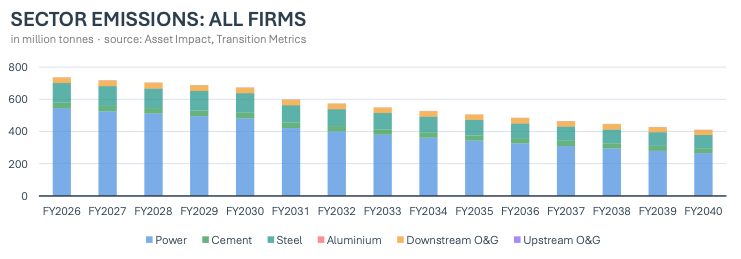
Scope 1 emissions are dominated by the power sector, with steel a distant second and cement, aluminium and oil & gas making up the remainder. Asset Impact's projections show annual emissions falling from roughly 750 million tonnes of CO2 in 2026, to just over 400 million in 2040.
A 1 GW coal plant running at a 70% capacity factor emits roughly 5 million tonnes of CO2 a year. At JPY 5,000 per tonne, a mid-pricing-corridor estimate for 2036, this equates to about JPY 25 billion (USD 150 million) in annual carbon compliance costs. Most Japanese coal plants do not earn operating profits on that scale, so any switch away from allowances to auctioning is likely to make them loss-making.
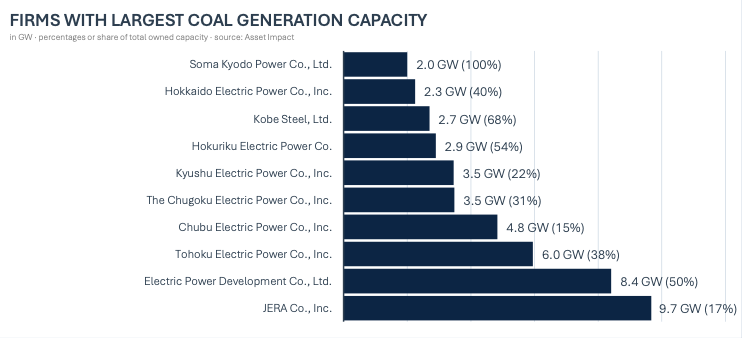
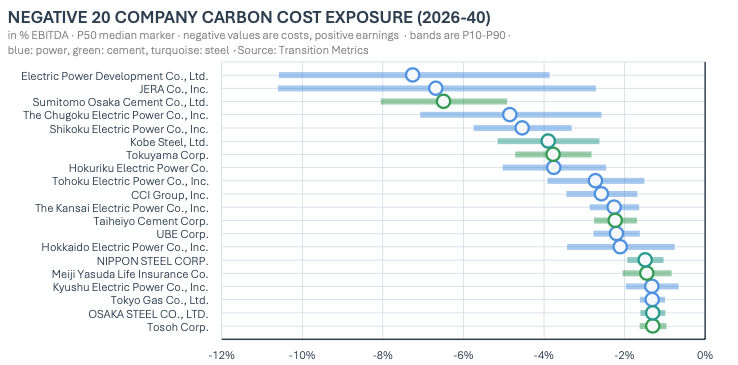
Coal plant ownership is also concentrated. JERA, Japan's largest generator, runs about 57 GW of thermal capacity with gas as the dominant fuel, but its 9.7 GW of coal is the largest coal position in the country. Electric Power Development (J-POWER) has 8.4 GW, half of its owned capacity. On our modelling J-POWER is the most exposed name in the portfolio, with annual compliance cost reaching about 30% of cost of sales by 2040. The regional utilities Tohoku, Chugoku and Kyushu run coal fleets that face the same step-change from FY2033.
Electric arc furnace producers such as Tokyo Steel Manufacturing emit roughly 0.15 to 0.2 tonnes of CO2 per tonne of steel on a Scope 1 basis. Blast furnace and basic oxygen furnace producers emit about 1.9 tonnes. Because compliance cost tracks Scope 1 emissions, EAF operators start with a per-tonne cost advantage of roughly an order of magnitude, and it grows as benchmarks tighten.
BOF producers have limited room to respond before 2030. Nippon Steel has announced hydrogen direct reduced iron ambitions, but commercial deployment is not expected before 2040 at the earliest. The realistic near-term route is converting blast furnaces to electric arc furnaces, which is slow and capital-intensive. Steel also sells into globally traded markets, so Japan-specific carbon costs cannot be passed to buyers in Korea, China or India without losing volume.
Two open questions have the potential to change the numbers significantly. The first is the government's policy on allowance banking. METI has not confirmed whether surpluses can be carried across periods, which decides whether a company holding allowances in 2030 can use them against a 2035 deficit. That is a capital allocation question analysts should be putting to management now.
The second is whether auctioning extends beyond power. Our base case assumes steel, cement, aluminium and oil and gas keep full free allocation through 2040. If METI extends mandatory auctioning to industry from 2033 or 2035, the portfolio cost rises by 50 to 65% and steel moves from roughly breakeven to a net cost of JPY 350 to 400 billion. Pressure from the EU carbon border adjustment mechanism could bring that forward.
Want to find out more about the data powering this analysis? Get in touch via the link below.
Cover image by Σ64 - Own work, CC BY 4.0.
Looking for more details on our forward-looking asset-based data? Our team is here to support you.
Contact us